Why Profitable Businesses Still Run Out of Cash
Here's the situation I see constantly: a business owner shows me a P&L with solid margins, and then shows me a bank account that's nearly empty. They're not doing anything wrong. They're just confusing profit with cash.
Profit is an accounting concept. Cash is what's in your account on Tuesday morning.
The gap between them is timing. A few examples of how it shows up:
- You invoice a client $18,000 in March. They pay on Net 45. That revenue hits your P&L in March, but the cash doesn't land until mid-May.
- You buy $6,000 in inventory or materials upfront. You won't invoice for the finished work until next month.
- You pay quarterly estimated taxes in one lump sum. Your P&L spread that expense across the year - your bank account didn't.
- Payroll hits every two weeks regardless of when clients pay.
This is the core problem with managing cash flow in a business: the income statement shows you what happened; the cash flow statement shows you what you can actually spend. Most small business owners are running their decisions off the wrong report.
The 5 Core Habits of Small Business Cash Flow Management
Good business cash flow management isn't complicated. It's consistent. These five habits, done regularly, will do more for your financial stability than any software or strategy session.
1. Maintain a rolling cash flow forecast.
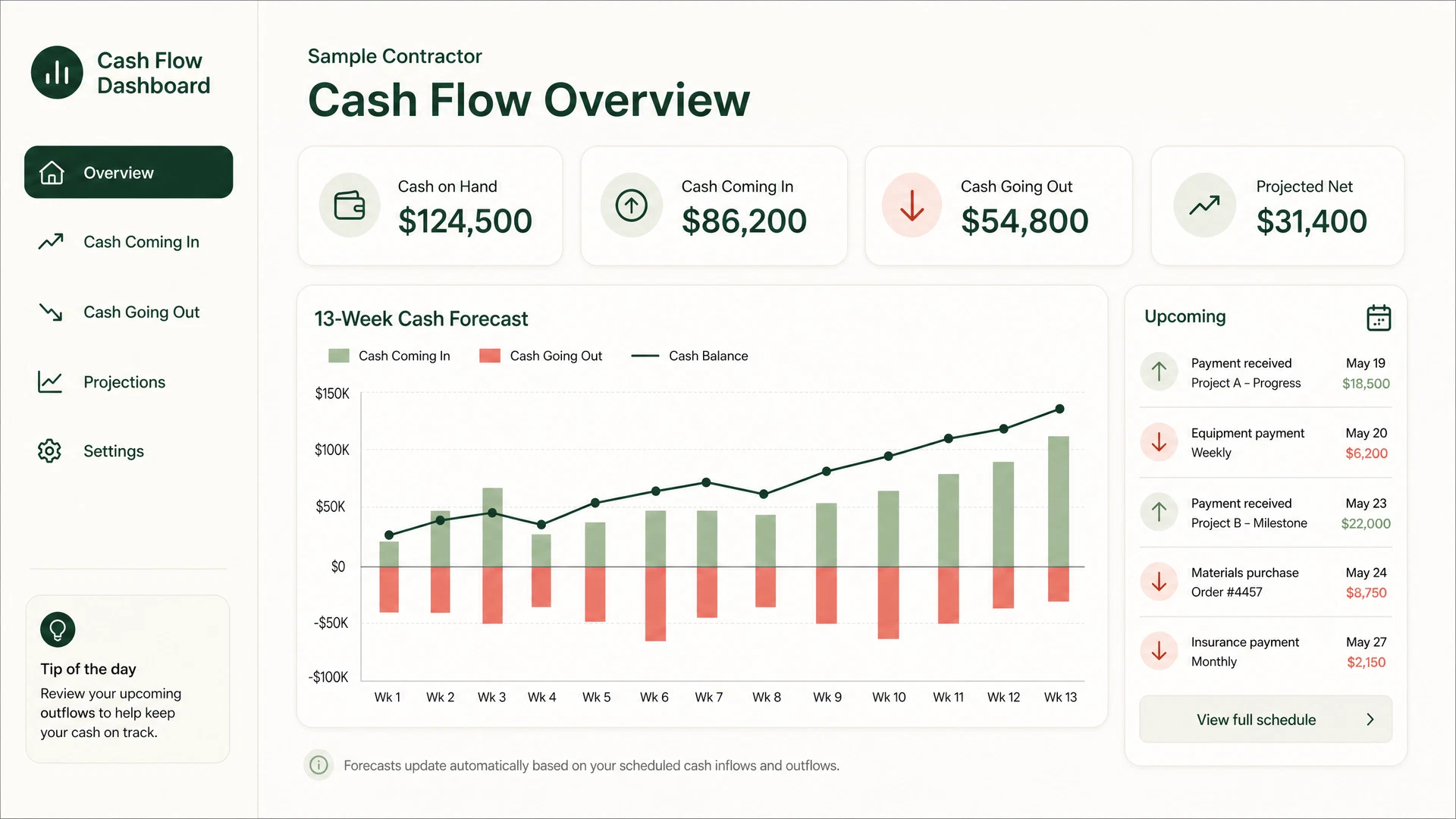
Know what's coming in and going out over the next 8–13 weeks. Not a budget - a forecast. Actual expected deposits, actual scheduled payments. Update it weekly. This one habit alone changes how you make decisions.
2. Keep separate accounts for operating cash, taxes, and owner pay.
One account for everything is a recipe for confusion. At minimum: an operating account, a tax reserve account (move a percentage of every deposit in automatically), and a dedicated account for your own compensation. Clarity by design.
3. Speed up receivables - aggressively.
Every day a receivable sits unpaid is a day you're financing your client's business. Send invoices the same day work is delivered. Offer ACH or card payments. Follow up on Day 1 past due, not Day 30. Consider requiring deposits for larger projects. A 10-day improvement in your average collection time can free up thousands in working capital.
4. Time your outflows intentionally.
You don't have to pay every bill the day it arrives. Pay on the due date, not before. Negotiate Net 30 or Net 45 terms with vendors where you can. Batch discretionary spending to weeks when you know cash is higher. This is how to manage cash flow for small business without cutting anything - just shifting timing.
5. Treat owner pay as a fixed line item.
This is the one most owners skip. If you only pay yourself what's left over, you'll always feel broke - even in good months. Set a consistent owner draw or salary, put it in the forecast, and treat it like any other obligation. This forces the business to actually support you, which is the whole point.
How to Build a Simple Cash Flow Forecast
A cash flow forecast doesn't need to be a 40-tab spreadsheet. Here's how to build one that actually gets used.
Step 1: Start with your opening bank balance.
Pull the actual balance from your operating account as of today. That's your starting point.
Step 2: List every expected cash inflow for the next 8 weeks.
Include outstanding invoices (with realistic payment dates, not invoice dates), scheduled deposits, retainers, and any other expected receipts. Be conservative - if a client is slow, reflect that.
Step 3: List every expected cash outflow.
Payroll, rent, loan payments, vendor invoices due, subscriptions, estimated tax payments, owner draws. Include everything with a due date.
Step 4: Calculate your weekly ending balance.
Opening balance + inflows − outflows = ending balance. Roll that ending balance forward as the next week's opening balance.
Step 5: Look for the valleys.
Any week where the ending balance dips below your comfort threshold (I usually suggest a minimum of one month's fixed expenses) is a week that needs attention - now, not when it arrives.
Step 6: Update it every week.
A forecast you update weekly is a decision-making tool. A forecast you build once is a document.
A simple Google Sheet works fine for most businesses under $2M in revenue. The discipline matters more than the tool.

The Most Common Cash Flow Mistakes Small Business Owners Make
After working inside hundreds of small business finances, the same mistakes come up again and again. Here's what to watch for.
Mistake 1: Using the bank balance as your financial dashboard.
Your bank balance tells you what's there right now. It doesn't tell you about the $12,000 payroll hitting Friday or the $8,500 tax payment due next week. Running on bank balance alone is like driving by looking in the rearview mirror.
Mistake 2: Mixing business and personal finances.
When personal expenses run through the business account - or business cash gets used to cover personal shortfalls - you lose all visibility into what the business actually needs. Separation isn't just an accounting best practice; it's a survival habit.
Mistake 3: Ignoring receivables until they're a crisis.
Slow collections are a cash flow problem masquerading as a customer relationship problem. Most owners wait too long to follow up because it feels awkward. Build a collections process that's automatic and professional - not personal.
Mistake 4: Treating a good month like a new baseline.
One strong month doesn't mean cash flow is solved. Seasonal businesses especially fall into this trap - spending in Q4 based on Q3 revenue, then hitting Q1 completely dry. Manage cash flow effectively by looking at trailing 12-month patterns, not last month's number.
When Cash Flow Management Becomes a System Problem
Spreadsheets and good habits will take you a long way. But there's a point - usually somewhere between $750K and $2M in revenue - where managing cash flow in a business gets complex enough that a spreadsheet stops being the right tool.
Signs you've hit that point:
- You have multiple revenue streams with different payment timing
- You're carrying payroll for a team of 5 or more
- You're making significant inventory or equipment investments
- You've started using a line of credit to smooth cash gaps (which works, but shouldn't be the permanent solution)
- You're making major decisions - hiring, pricing, expansion - without a clear view of what the next 90 days look like
This is where a financial operating system becomes worth building. Not just a forecast, but an integrated set of processes: cash flow tracking, owner compensation structure, tax reserve management, and reporting that actually tells you what's happening in real time.
It's also where having a fractional CFO in your corner - someone who's inside your numbers regularly, not just at tax time - changes the quality of decisions you make.
If your bookkeeping services are keeping your books clean but nobody's translating those books into forward-looking financial decisions, that's the gap. Clean books are the foundation. Cash flow management is what you build on top of them.
Book Your Financial Check-InFrequently Asked Questions
What is cash flow management in business?
Cash flow management is the process of monitoring, analyzing, and timing the money flowing into and out of your business. The goal is to make sure you always have enough cash on hand to meet your obligations - payroll, vendors, taxes, debt service - while also paying yourself and investing in growth. It's distinct from profitability: a business can be profitable on paper and still fail from poor cash flow timing.
How do I improve cash flow in my small business?
The fastest levers are usually on the receivables side: invoice immediately, offer easy payment methods, and follow up on overdue invoices within 24 hours of the due date. On the outflow side, pay on due dates rather than early, and negotiate longer terms with vendors. Building a rolling 8-week cash flow forecast gives you the visibility to act before problems arrive rather than after.
What causes cash flow problems in small businesses?
The most common causes are slow collections (long receivables cycles), rapid growth that requires cash outflows before revenue catches up, seasonal revenue patterns with fixed monthly expenses, and owner draws that aren't planned into the forecast. Mixing business and personal finances also obscures the problem until it's severe.
What's the difference between profit and cash flow?
Profit is revenue minus expenses as recorded on your income statement - it's an accounting figure that includes money you've earned but haven't yet collected. Cash flow is the actual movement of money in and out of your bank account. You can show a profit while being cash-negative if clients haven't paid yet or if you've made large upfront investments. This is why managing cash flow in a business requires its own separate focus, not just a look at the P&L.
How often should I review my cash flow?
Weekly, at minimum. Update your rolling forecast every Monday morning - it takes 20 minutes once the habit is built. Do a deeper monthly review to look at patterns: Are collections getting slower? Are certain expense categories creeping up? Are you consistently thin in certain weeks? The weekly cadence keeps you out of crisis; the monthly review helps you improve the system.
Useful Sources
- SBA: Manage Your Finances - The SBA's core guide to financial management for small business owners, including cash flow projection tools.
- SCORE: Cash Flow Management Resources - Free templates, guides, and a 12-month cash flow statement template from SCORE's small business education center.
- SCORE: Mastering Cash Flow Management (Course) - A free online course covering cash flow forecasting, receivables, and seasonal planning.
- IRS Publication 538: Accounting Periods and Methods - The IRS's official guidance on cash vs. accrual accounting methods and how your choice affects when income and expenses are recognized.